Not a fanboy, but
SELF JAB TO THE JAW
We left the last episode on a cliffhanger, and we will get back to it soon, but first we need a little more context to put my impressions into perspective. I do not hold a black belt in LeetCode. The last time I reversed a linked list was at university. I am a robotics engineer, which means I don't do anything very well, but I do a lot of things in a mediocre way. Yeah, I know some math, mechanics, physics, electronics, computer science and programming. You can easily find someone who does any of them a lot better than me. That is also true for the whole software development life cycle: design, implementation, testing, maintenance and so on. To me these are tools to get things done. I have a problem, a task or a wish, and I write code to solve it. Nothing more than that. Usually I do not write code because it gives me joy. Ofc I can still end up being proud and feeling good about the outcome.
I am also pretty lazy and prefer pragmatic programming (shout out to my bible, The Pragmatic Programmer by Hunt and Thomas). As a typical CLI cowboy, design docs, UML and testing were always something I'd rather avoid. LLMs are not lazy. They will happily write 40 unit tests for a function that adds two numbers. Agentic coding has changed my workflow a lot. Now I have started to appreciate the practices I used to skip. More on that in a future episode.
TRIAL AND ERROR
As described in the previous episode, my usual workflow goes from A to B, but via A.n, almost.B, final.B and final.final.B, so in no way a textbook waterfall model. It looks a lot like this comic:
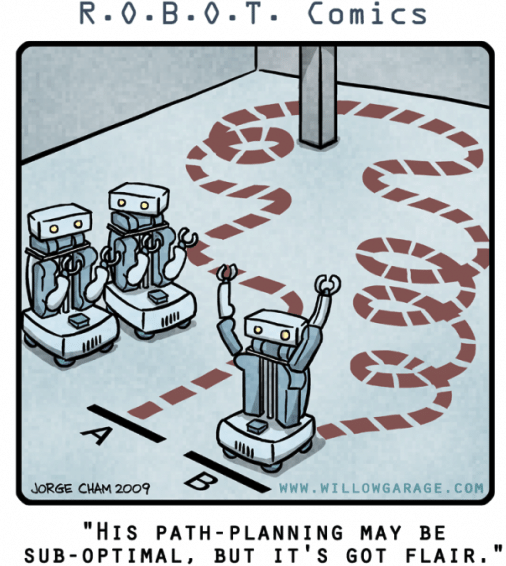
Comic: Jorge Cham, R.O.B.O.T. Comics (2009).
It is hard to redo the same task without being biased by the experience gained on the first try. Still, I estimate that my newfound appreciation for "old school" rigid practices like UML and design docs has already made my path to B a lot shorter. No wonder those practices have stood the test of time for decades.
Without LLMs I would likely fall back on my old habits a bit more. Come on, who wants to spend their time writing tests and documentation when there is a real task to solve with code? Natural language goes stale tonight, and test coverage will not work well to hammer anything.
THE SHORTCUT
So, back to my watershed moment with Opus 5.5. To make it clear, I am no fanboy, and I hope there will soon be open-weight models capable of doing the same. It is also very likely that other closed models can achieve the same, but I don't know. Anyhow, I gave Opus a fair description of a feature I have had on my mind and in my backlog for about a year. It is something I could have designed and implemented on my own, but it would have taken me a substantial amount of time and effort. It is hard to say how long, thanks to my usual non-deterministic route from A to B, but weeks if not months. Opus in Ultracode spun up I don't know how many reviewer and critic agents, and started by ripping my design doc apart and suggesting what to do instead. I was a little surprised, and perhaps mostly skeptical, but I accepted the suggestion and a little later it was done. Done, as in not what I thought I wanted, not what I had asked for, but how the actual version should have been, directly from A to B.
It was not waterfall style for Opus in Ultracode either. There were many iterations, and none of them needed me for anything. Writing this gives me goosebumps again, and I still can't tell if I am scared and/or excited. Either way, I am extremely impressed. That feature has now been running live in a SaaS of mine for two weeks, used by dozens of people I have never talked to, with no bug reports or log glitches. Trust me bro, I have checked the logs more often than my email.
For those of you reading along, thinking you have a lifetime career ahead of you typing code, I honestly don't know what to tell you. I am not saying we are being replaced tomorrow, but if I look back at the evolution since the browser LLM chats three years ago, I have no way of guessing the need for human programming in, say, 20 or even 10 years. It is probably safe to generalize and say that most developers thought the agentic coding capability had more or less plateaued. Not much had changed this year. We felt it was pretty good and getting slightly better with each model release, but no big leaps. We were indeed wrong.
OBAMA ON THE SCALE
You might be thinking: “Oh Lars, did you have one too many again, or did you simply just lose your mind?” Maybe both. It is not like I claim to have found a magic 8-ball, quite the opposite actually. I have no idea where this will go, and today I know even less than I thought I did two months ago.
Let me tell a little story. During my university days I attended Stanford's free online computer vision course, CS231n, back in 2018. One example stuck with me and came to mind again recently: a photo of President Obama sneakily putting his foot on a scale while a guy weighs himself, and the people in the back trying not to laugh. It comes from Andrej Karpathy's 2012 blog post, "The state of Computer Vision and AI: we are really, really far away."
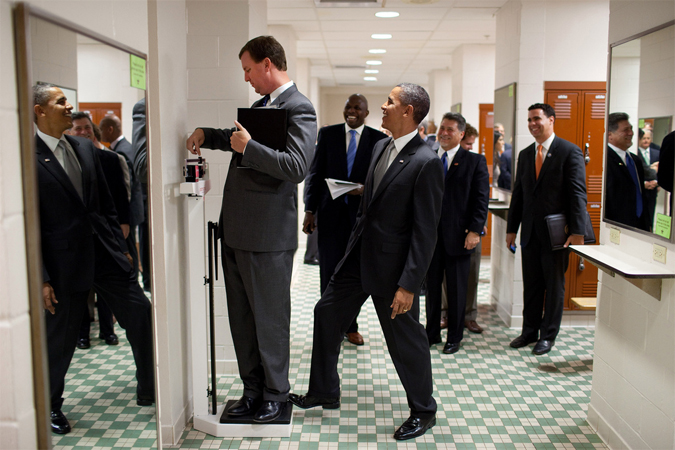
Photo: Pete Souza, official White House photo (2010), via Karpathy's post.
He listed everything you need to know to get the joke: mirrors, how a scale works, that people are touchy about their weight, and that the guys in the back know the guy on the scale doesn't know. His conclusion was that we were very, very far away, and might even need robots with years of lived experience.
Six years later, in 2018, the course was still showing that photo, because not much had changed. Machines could tell you there were people in a hallway, but not why it was funny.
I am not throwing shade at Karpathy. He was and is probably one of the sharpest people in that field. He co-founded OpenAI, led AI and Autopilot Vision at Tesla, and this year joined Anthropic. That is exactly my point: for years the people at the very frontier saw a long and unclear road. Today anyone on the street can whip out their phone and have it explain the joke layer by layer. Not code from frontier research programs on some super quantum computer in a secret NSA cleanroom that does not exist, just a simple phone, barely smarter than a toaster. Hell, I think my toaster almost has an LLM and a subscription by now. I should test if it can explain the joke to me.
THE NEXT ABSTRACTION LEVEL
Eleven years after his far away post, in 2023, the same Karpathy wrote: "The hottest new programming language is English."
I have been to a few rodeos, but there are cowboy hats out there that have seen a lot more sun than mine. Those hats went from punch cards to assembly, and from assembly to high-level languages. Each step moved us one level of abstraction further away from the metal. Now the next one is taking shape. I am pretty sure the assembly programmers were just as freaked out when Fortran showed up and a compiler started writing their code. But that is a story for another episode.
HAT SOUP
Self-hosting open-weight models has taught me a lot, including what the metal costs, meaning hardware and electricity. Based on that alone, I am pretty sure that me maxing out my plan every week is losing someone money, a lot of it. And that is before counting all the resources that went into training and selecting the model. I will eat my cowboy hat the day these plans can pay for themselves. Somebody is paying for my late-night fun, and for now it is not me. We still need to remember that it is not doing anything that I, or better yet a group of people, could not do. I could have outsourced the same task to humans, and they would have returned an on-par solution. Just not the same night, and at a substantially higher cost. There is no way for me to estimate the actual cost of that late-night Ultracode session, so how much higher, I will leave unspoken. Me and my tinfoil hat have seen this movie before. It is cheap and amazing until everyone is dependent and locked in, and then the real bill arrives. How big? I guess we will have to wait and see. For sure I am not removing my local Qwen 3.8 just yet, and I hear rumors that Christmas might come early this year in the form of Qwen 4.
Thanks for “listening” to my yap, see ya next week.